

How Can You Tell a Real Eames Stool?
In the expansive and highly sought-after world of mid-century modern design, few pieces hold the iconic status and versatile charm of the solid wood turned stool. Whether utilized as supplementary seating, an elegant side table, or a sculptural accent piece, these sculptural wooden blocks are a staple of sophisticated interior design. However, as the secondary market for mid-century modern furniture continues to expand, collectors, interior designers, and homeowners frequently encounter a challenging dilemma: how to tell a real Eames stool from a mass-produced imitation or a high-quality homage. Understanding the subtle nuances of wood grain, dimensional accuracy, and manufacturer markings is essential for anyone navigating this market.

From our experience as industry professionals specializing in premium furniture reproduction, we know that authenticating vintage and contemporary designer furniture requires a meticulous eye for detail. The genuine article possesses specific characteristics dictated by its historical manufacturing processes and the exacting standards of its original designers. In this comprehensive guide, we will explore the historical context of these magnificent pieces, break down the exact dimensional and material cues you need to look for, and explain how to tell a real Eames stool. Furthermore, we will discuss when and why a meticulously crafted replica, such as the Wenaifurniture Replica Eames Style side table turned stool, might be the most practical and aesthetically pleasing choice for your residential or commercial space.
Table of Contents
- 1. The Historical Context of the Time-Life Design
- 2. Material Analysis: Solid Walnut and Wood Grain
- 3. Examining the Three Distinct Profiles
- 4. Dimensional Accuracy and Proportions
- 5. Manufacturer Markings and Authentication Tags
- 6. The Role of High-Quality Replicas in Modern Design
- 7. Summary Table: Spotting the Differences
- 8. Frequently Asked Questions (FAQs)
- 9. References
1. The Historical Context of the Time-Life Design
Before you can accurately determine how to tell a real Eames stool, you must understand the history behind its creation. This Eames Time Life stool is designed by Eames in 1960 as a low table for the Time-Life Building in New York. The ambitious architectural project required furnishings that were both monumental in their solidity and graceful in their execution. Charles and Ray Eames were commissioned to design pieces for the ultra-modern lobbies of this iconic skyscraper. Out of this commission came the famous Time-Life chair, and alongside it, these solid wood turned stools.
Following the completion of the Time-Life Building commission, the stools became Ray Eames favourite seats/side tables. They were liberally scattered about the Eames home in Pacific Palisades, California, serving as plant stands, occasional seating, and functional art objects. Knowing this history is the first step when you are trying to tell a real Eames stool, as the original intent was to create a piece of no-fuss utility that possessed immense physical presence and structural integrity.
2. Material Analysis: Solid Walnut and Wood Grain
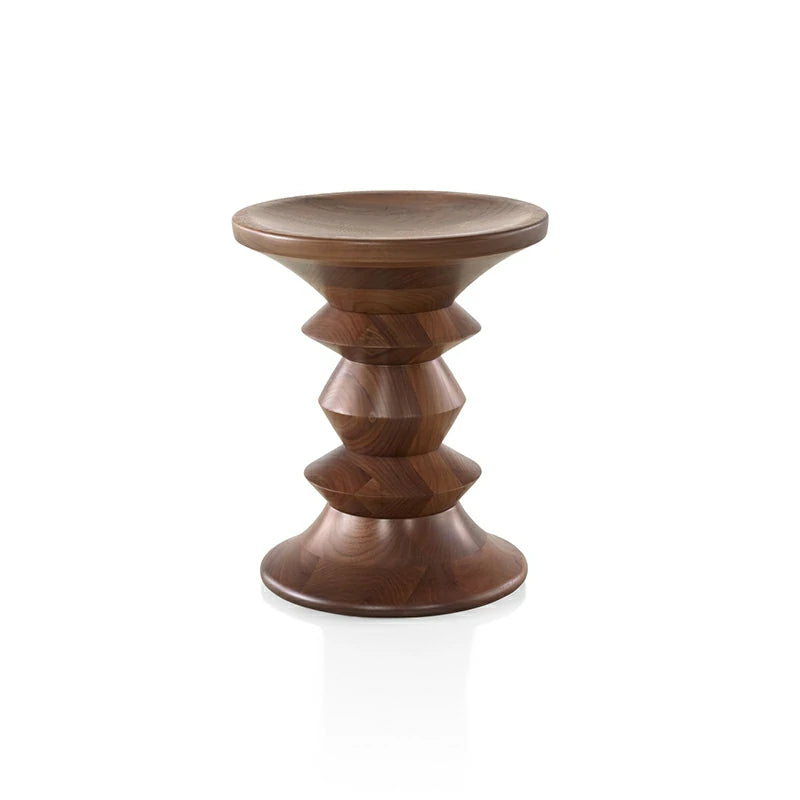
One of the most definitive ways to tell a real Eames stool is to thoroughly examine the material composition. The authentic stools produced by Herman Miller are traditionally turned from solid blocks of solid walnut. Walnut is a premium hardwood characterized by its tight, complex grain patterns and rich, dark color variations. When you are assessing a potential original, you must look closely at the end grain visible on the top and bottom of the stool. Because the stool is turned from thick sections of wood laminated together, you should be able to identify the distinct glue lines where the solid walnut blocks were joined prior to being placed on the lathe.
From our experience, inferior counterfeiters often attempt to replicate this look using cheap softwoods covered in a walnut veneer. You can immediately tell a real Eames stool because an original will never utilize veneer on its heavily sculpted profiles; the complex curves make veneering impossible. The piece must be solid wood through and through. Furthermore, an authentic walnut stool is exceptionally heavy, often weighing in excess of 20 pounds. If you pick up a stool and it feels hollow or unexpectedly light, it is highly likely you are holding a low-grade fake.
3. Examining the Three Distinct Profiles
The original Herman Miller catalog featured specific geometric shapes. To tell a real Eames stool, you must memorize these silhouettes. They are available in three different profiles, each designed to complement the others while retaining a unique sculptural identity. When assessing authenticity, check the symmetry and sharpness of these turnings.
- Profile A (Diamond): This shape features a central, protruding angular ring that resembles a flattened diamond profile. It is arguably the most recognizable of the three.
- Profile B (Round): This profile is characterized by smooth, undulating convex and concave curves, resembling a traditional chess piece or a heavily stylized goblet.
- Profile C (Inverted Diamond): Also known as the hourglass, this profile pinches inward at the center, creating a striking negative space that draws the eye.
Another crucial element to look for when you want to tell a real Eames stool is the top surface. A genuine article always comes with a concave top. This shallow depression was a deliberate ergonomic choice by Ray Eames, allowing the piece to function comfortably as supplementary seating rather than just a flat side table. If the top of the stool is perfectly flat, it is a definitive sign that the piece is not an authentic Herman Miller production.
4. Dimensional Accuracy and Proportions
Precision is the hallmark of mid-century modern manufacturing. The proportions of the Time-Life stools were mathematically calculated to harmonize with standard lounge seating. To tell a real Eames stool, you must arm yourself with a measuring tape. The standard dimensions of an authentic Herman Miller stool are approximately 15 inches (38 cm) in height and 13 inches (33 cm) in diameter.
These dimensions are vital. Many unauthorized knock-offs are produced either too tall or too narrow, ruining the robust, squat aesthetic that makes the original design so appealing. We recommend physically measuring the top diameter, the bottom base diameter, and the overall height. While solid wood can shrink or expand marginally over decades depending on humidity, a deviation of more than half an inch in any direction is a strong indicator that you are not looking at a genuine artifact.
5. Manufacturer Markings and Authentication Tags
The most straightforward method to tell a real Eames stool is to check the bottom base for official manufacturer markings. Since their introduction in 1960, Herman Miller has utilized various labeling systems to authenticate their furniture. Depending on the era in which the stool was produced, you should look for specific identifiers.
Vintage stools from the 1960s and 1970s often feature a foil sticker or a black rectangular label with the Herman Miller logo. Later production runs may feature a circular metal medallion embedded into the wood on the underside of the base. Contemporary models produced in the 21st century typically feature a laser-engraved Herman Miller logo, along with the signature of Charles and Ray Eames, directly on the wood. However, from our experience, paper labels can fall off over time, and metal medallions can be lost. Therefore, while the presence of a label is a fantastic way to tell a real Eames stool, the absence of a label does not automatically guarantee it is a fake. You must use the label in conjunction with material and dimensional analysis.
6. The Role of High-Quality Replicas in Modern Design
While knowing how to tell a real Eames stool is crucial for vintage collectors, purchasing an original Herman Miller piece often involves an exorbitant financial investment, sometimes costing thousands of dollars per stool. For interior designers, architects, and homeowners who desire the iconic mid-century aesthetic without the prohibitive price tag, high-quality replicas are the ideal solution.
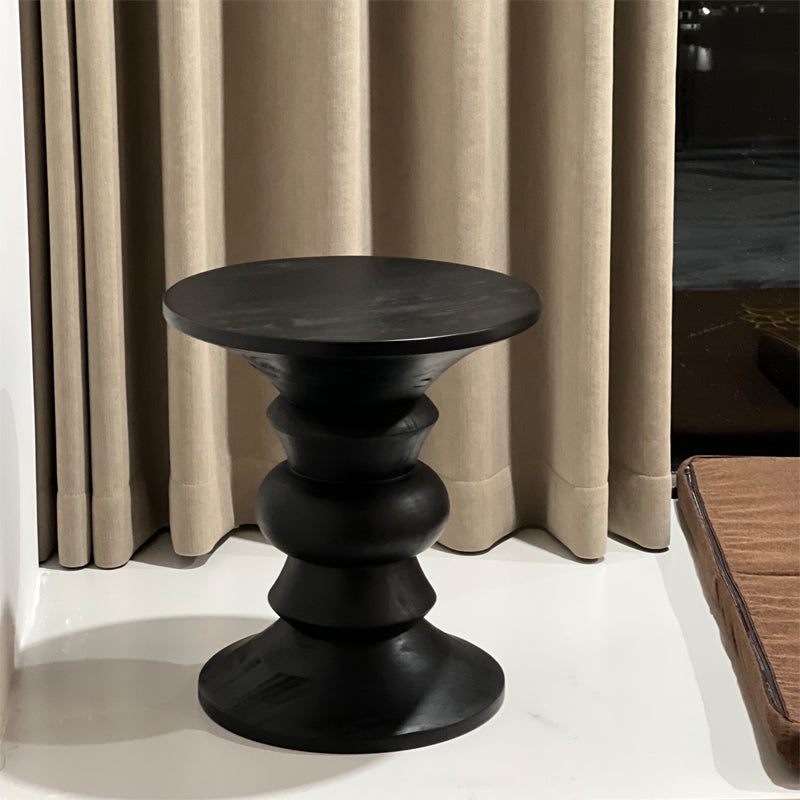
We recommend the Wenaifurniture Replica Eames Style side table turned stool. We understand the design philosophy behind the originals, which is why our reproductions respect the exact geometric profiles that made the 1960 design famous. Available in three profiles: A Diamond, B Round, C Inverted Diamond, our stools combine the sumptuous solidity of rich dark stain with the no-fuss utility of furniture that can be moved anywhere as needed.
Instead of the highly expensive and increasingly rare solid walnut, the Wenaifurniture material is rubber wood. Rubber wood is an exceptionally durable, eco-friendly hardwood that accepts dark stains beautifully, mimicking the luxurious depth of vintage walnut while remaining environmentally sustainable. Our stools maintain the exact mid-century proportions, with dimensions of 33cm x 38 cm, and faithfully replicate the ergonomic concave top. By choosing a premium replica, you achieve the sophisticated aesthetic of the Time-Life Building era while maintaining a practical budget.
7. Summary Table: Spotting the Differences
To assist you in your pursuit of mid-century modern design, we have compiled a quick-reference table outlining the key differences you will observe when attempting to tell a real Eames stool from a high-quality replica or a poor counterfeit.
| Feature | Authentic Herman Miller Eames Stool | Wenaifurniture High-Quality Replica | Low-Quality Counterfeit |
|---|---|---|---|
| Material | Solid Walnut (Turned from glued blocks) | Solid Rubber Wood with rich dark stain | MDF with cheap wood veneer or hollow plastic |
| Top Surface | Concave for seating comfort | Concave top, faithful to original design | Perfectly flat top |
| Dimensions | Height: 38 cm, Diameter: 33 cm | Height: 38 cm, Diameter: 33 cm | Incorrect proportions (often too tall or narrow) |
| Profiles Available | A (Diamond), B (Round), C (Inverted Diamond) | A Diamond, B Round, C Inverted Diamond | Generic, unsymmetrical turnings |
| Markings | Herman Miller foil label, medallion, or laser engraving | Unbranded or proprietary manufacturer marking | Fake vintage labels or completely unmarked |